Swiss natural skincare brands: an overview to help you choose
SWISS NATURAL SKINCARE
Swiss natural skincare brands fall roughly into four groups: long-established houses, retailers’ own brands, small independent makers and young direct-to-consumer brands. Which one suits you depends less on the name than on three questions: where the products are made, how openly the ingredients are declared, and how many products you really want to use.
Which Swiss natural skincare brands are there, and how do they differ?
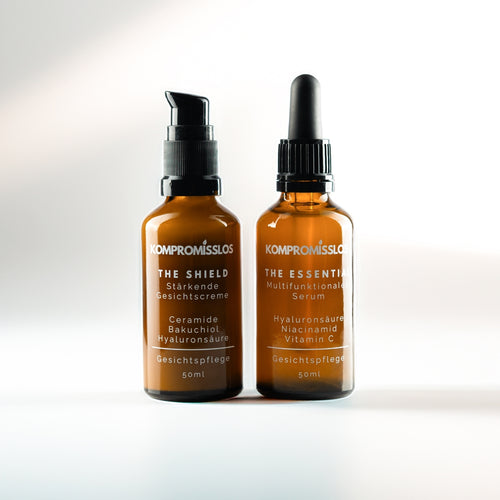
The Swiss market divides into four types of brand, which differ clearly in the breadth of their range, their price and how close they are to production. First, there are the long-established houses with decades of history and a range stretching from hand cream to toothpaste. Second, retailers’ own brands, which you’ll find in every branch and which work mainly on price and availability. Third, small independent makers, often producing soaps, oils and balms, some of them made by hand in small batches. And fourth, young direct-to-consumer brands that sell online, keep a narrow range and usually disclose their active ingredients openly. That fourth group is where we belong, with our serum and cream. Names such as Weleda, Farfalla, Soeder, Biokosma or Naturaline appear in almost every overview of Swiss natural skincare, but they cover quite different groups among these four. Alpine plants run through all four types as a raw material, edelweiss or gentian root extract, for example. That is part of the story, but it says nothing yet about how much ends up in the finished product.
| Type of brand | Typical features | Where you’ll find it | Suits you if you |
|---|---|---|---|
| Long-established house | Broad range, well-known formulas, often certified | Chemist’s, pharmacy, online retailers | want everything from one source |
| Retailer’s own brand | Low price, large volumes, straightforward basic care | Branches of the big retailers | shop with an eye on price |
| Independent maker | Small batches, soaps and oils, often regional raw materials | Farm shops, markets, their own online shop | are looking for handmade and regional products |
| Online direct-to-consumer brand | Narrow range, open disclosure of active ingredients, no middlemen | Only in the brand’s own shop | want to use a few products in a targeted way |
What does it mean when a brand calls itself a Swiss brand?
A Swiss brand name on its own says nothing about where a product is made. Only the indication of origin itself is regulated by law. For industrially manufactured products, which include cosmetics, the Swiss Federal Institute of Intellectual Property states that at least 60% of manufacturing costs must be incurred in Switzerland and that the step which gives the product its essential characteristics must also take place here. A brand that doesn’t reach this threshold may still advertise individual activities, such as development or filling in Switzerland, but may not describe the product as a whole as a Swiss product. In everyday terms, this means a head office in Zurich, an edelweiss on the packaging and a German-language brand name are three different things. If origin matters to you, look on the website for a concrete statement about production and filling rather than for symbols.
How can you tell whether “natural skincare” means anything?
Natural skincare is not a legally defined term, so the word on the packaging tells you little on its own. Private standards such as NATRUE or COSMOS provide guidance by setting out which raw materials are permitted and which are not. NATRUE works with two levels, natural cosmetics and organic cosmetics, and for the higher level requires at least 95% of the natural and near-natural substances to come from certified organic farming. Certification is not carried out by the label itself but by independent accredited bodies. If a brand has no seal, it isn’t automatically worse. But then what counts is how transparently it communicates: is the full INCI list online before you order, are the active ingredients named with their concentrations, and do you find out what was deliberately left out? The more concrete the answers, the better you can judge for yourself whether a product suits your skin.
Vegan and natural skincare are not the same thing. Vegan simply means that no animal-derived raw materials are included. A vegan formulation can contain synthetic substances; conversely, certified natural skincare can contain beeswax or lanolin.
What should you look for when buying Swiss natural skincare?
When you buy, four checks are worthwhile, and together they take you less than five minutes. First, the ingredient list: it is sorted in descending order of quantity, so whatever is right at the front makes up the largest part of the formula. Second, the information on active ingredients: a brand that states 5% niacinamide or 2% hyaluronic acid makes itself comparable; a brand without figures does not. It is also useful to know which active ingredients work well alongside each other before you combine two brands. Third, tolerance: fragrances, including natural essential oils, are among the more common triggers of reactions in sensitive skin. Fourth, the returns policy, because skincare can only be judged after a few weeks. That is why we offer a 100-day right of return, delivery for CHF 3.70 and free on orders over CHF 60, and delivery within 1 to 3 working days. You can read how other customers experienced the switch in the feedback on the Duo.
A large range or just a few products: which suits you better?
The breadth of a brand’s range is the difference that shapes your daily routine most, and both approaches have their place. A broad range gives you choice: cleanser, toner, eye cream, mask, sun protection, all designed to work together. That makes sense if you enjoy skincare as a ritual and like to vary it. A narrow range takes that choice away from you but makes one thing easier in return: judging the results. If you introduce eight new products at once and your skin reacts, you won’t know what it is reacting to. That is exactly why we have limited ourselves to two products, a serum and a cream, together as The Duo for CHF 109.90. How they follow each other morning and evening is explained in the how-to-use guide. Depending on how often you use it, a bottle lasts 2 to 4 months. If you find something missing, you can add to your routine at any time – just one product after another rather than all at once.
When is another brand the better choice?
There are four situations in which you are better off with another Swiss brand than with us. First, if you need a recognised natural skincare seal because you rely on it for guidance: we don’t carry one. Second, if you are looking for body care, hair care, make-up or sun protection, because we don’t offer any of those. Third, if fragrance is part of the skincare experience for you; you are more likely to find what you want from independent makers who work with essential oils. Fourth, if you have an acute change in your skin that worries you, such as intensely itchy, weeping or suddenly appearing patches. That belongs with a dermatologist, not in a skincare routine, whatever the brand. Cosmetics care for and support the skin barrier; they don’t replace a medical assessment. For everything in between – calm, everyday basic care without constantly switching products – a narrow range is an honest option. Be honest with yourself about whether any of the four situations applies to you before you order.
When I was building Kompromisslos, the question of a seal came up early on. I decided against it and disclosed the concentrations instead: 5% niacinamide, 2% hyaluronic acid, 2% vitamin C as 3-O-Ethyl Ascorbic Acid, 0.3% bakuchiol, 2% edelweiss extract and 2% gentian root extract, each based on the Duo as a whole. A seal tells you which groups of raw materials are permitted. A number tells you how much of an active ingredient is actually in there. The second mattered more to me, because for years I bought products myself without knowing. If you need a seal for guidance, you are better off with a certified Swiss brand, and I say that without any resentment.
Frequently asked questions
What Swiss natural skincare brands are there?
Four types of brand exist side by side in Switzerland: long-established houses, the own brands of the big retailers, small independent makers and young direct-to-consumer brands with a narrow range. Names such as Weleda, Farfalla, Soeder, Biokosma or Naturaline appear in many overviews. Which brand suits you depends on the breadth of the range, transparency and price.
Is Swiss natural skincare automatically better for your skin?
No – origin alone says nothing about how well a product is tolerated or which active ingredients were chosen. What matters is the formula, the concentration of the active ingredients and whether your skin reacts to individual components. A Swiss head office is a feature of location, not proof of quality for your individual skin.
Does Swiss brand mean the products are made in Switzerland?
Not necessarily. A cosmetic product may only be described as a Swiss product if at least 60% of manufacturing costs are incurred in Switzerland and the essential manufacturing step takes place here. A Swiss company name or head office alone doesn’t meet these criteria. Look for a concrete statement about production and filling.
How do I recognise genuine natural skincare?
The term natural skincare is not legally protected, so what helps is either a recognised seal such as NATRUE or COSMOS, or a fully disclosed ingredient list. Check whether the brand names its active ingredients with percentages and whether it describes what it deliberately leaves out. Concrete information beats general promises about nature.
Where can I buy Swiss natural skincare?
That depends on the type of brand: long-established brands at chemists and pharmacies, own brands in the retailers’ branches, independent makers at markets and in their own shops, direct-to-consumer brands online only. Buying directly from the manufacturer’s shop is usually the only way to get questions about the formula answered directly.
Is certified natural skincare always the better choice?
No – a seal is a guide, not a verdict on quality for your skin. Certifications define the permitted groups of raw materials but say nothing about the concentration of active ingredients in the finished product. A non-certified brand that discloses its figures can be more transparent for you than a seal without numbers.
How many products from one brand do I really need?
For everyday basic care, a few products are usually enough, because you can only judge results if you don’t change several things at once. That is why we work with one serum and one cream, morning and evening: 3 to 6 drops and 3 to 6 pumps. Additional steps are possible but not necessary.