Niacinamide and vitamin C: can you really combine them?
INGREDIENT COMBINATIONS
You can combine niacinamide and vitamin C in the same routine without one cancelling out the other. The widespread warning goes back to two laboratory studies from the 1960s that examined pure substances in aqueous solution at almost 90 degrees Celsius. Finished skincare never reaches those conditions.
Why you can combine niacinamide and vitamin C
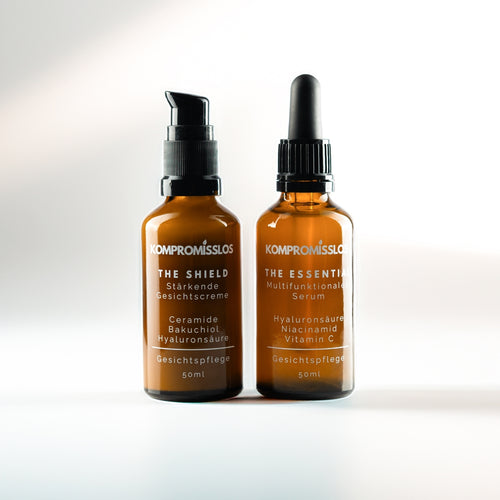
Combining niacinamide and vitamin C in finished skincare is not a problem, because the two ingredients work on your complexion in different ways and do not destroy each other in a stable formulation. Niacinamide is the amide form of vitamin B3 and is used for a more even-looking complexion and to support the skin barrier. Vitamin C is used as an antioxidant and can soften the look of dark spots. The two are not competing for the same target; they complement each other. That is exactly why they sit side by side in so many formulations: niacinamide and vitamin C come together in the Duo, with 5% niacinamide and 2% vitamin C as 3-O-ethyl ascorbic acid, each figure referring to the Duo as a whole. If you buy the two separately and apply them one after the other, that makes no difference to how well your skin tolerates them. So the real question is not whether you may use them together, but in what form and at what concentration.
Where the myth comes from: two studies from the 1960s
The myth goes back to two pharmaceutical studies from the early 1960s, both of which worked with pure substances in aqueous solution. In 1962, Per Finholt and Takeru Higuchi measured the rate at which niacinamide hydrolyses across a pH range of 0.4 to 11.3 in the Journal of Pharmaceutical Sciences – at 89.4 degrees Celsius. A year later, David Guttman and Dana Brooke described an interaction between nicotinamide and ascorbic acid in the same journal, in which a yellow colour forms immediately in aqueous solution. This produces a 1:1 complex whose extent depends on pH and is most pronounced at around pH 3.8. Over the decades, these two findings turned into the warning that niacinamide and vitamin C break each other down and trigger redness. Three details got lost along the way: the temperature, the purity of the substances, and the difference between a colour reaction and actual decomposition.
| Aspect | What the lab studies showed | What it means for your routine |
|---|---|---|
| Temperature | Niacinamide hydrolysis was measured at 89.4 degrees Celsius. | Your bathroom will never reach that temperature. |
| Substances | The studies looked at pure, single substances in aqueous solution. | Serums and creams are finished formulations with other components. |
| Yellowing | A 1:1 complex was described, peaking at around pH 3.8. | This is a colour reaction, not a breakdown into nicotinic acid. |
| Form of vitamin C | Free ascorbic acid was tested. | The Duo contains the derivative 3-O-ethyl ascorbic acid. |
What changes when the vitamin C is a derivative?
A vitamin C derivative shifts the whole question, because it does not bring the same chemistry as free L-ascorbic acid. Pure ascorbic acid is unstable and oxidises on contact with air, and its physicochemical properties are not ideal for absorption into the skin. This is described in a 2019 characterisation study in the International Journal of Pharmaceutics: X. The same study experimentally determined a pKa of 7.72 for 3-O-ethyl ascorbic acid. The ethyl group on the third carbon protects the hydroxyl group there from ionisation, and that is precisely why the molecule was developed as a stable form of vitamin C. What this means for you: the condition under which Guttman and Brooke saw their yellow complex most strongly was a highly acidic environment with free ascorbic acid. A derivative with a pKa of 7.72 behaves differently, as we explain in more detail in our piece on the stable form of vitamin C. You can see which form we actually use in the full ingredient list.
Apply them together or separate them morning and evening?
Applying them together works, applying them separately works too, and the decision depends less on chemistry than on how your skin tolerates them. If your skin is sensitive or you are only just starting with active ingredients, you can use vitamin C in the morning and niacinamide in the evening, so that you can trace any reaction to one or the other. If your skin is happy with both, using them together morning and evening saves time and products. And if both are already in the same set, the question of separating them does not arise at all. What does make a real difference is the order of textures: thin before rich, so serum first, then cream. We have covered separately which of the two ingredients should go on your skin first. The exact way to use the serum and cream – 3 to 6 drops and 3 to 6 pumps – is described on our how-to-use page.
Which concentrations make sense for this combination?
What makes sense is a moderate concentration of both, rather than the maximum of one. The Duo contains 5% niacinamide and 2% vitamin C as 3-O-ethyl ascorbic acid, both figures referring to the Duo as a whole rather than to a single product. On top of that come 2% hyaluronic acid, 2% edelweiss extract, 2% gentian root extract, 1% zinc and 0.3% bakuchiol. These levels are deliberately not at the top end of what is technically possible, and we have worked out separately the point at which higher percentages tip over. The reasoning is a calculation over time rather than over labels: depending on how often you use it, one bottle lasts you two to four months, and a stable form of vitamin C at a moderate concentration delivers more over that period than a high concentration that oxidises before you get there. The same applies to tolerance: an ingredient your skin accepts twice a day achieves more over weeks than one you give up after three days. The full breakdown is on the The Duo page.
When you can do without the combination
You can do without the combination if your complexion is stable and there is no specific reason behind it. Niacinamide and vitamin C do not solve a problem that is not there. If your skin is calm, well hydrated and free of bothersome pigmentation, you do not need an extra active ingredient – you need reliable basic care and consistent sun protection. Less is also the better choice if you have just introduced several new products at once: if your skin reacts, you will otherwise have no way of telling what caused it. And if what mainly bothers you is an unsettled, blemish-prone complexion, it is more worthwhile to look at your whole routine than at a single pairing of ingredients. Skin that is acutely irritated is not a case for extra active ingredients either: the priority then is calm and replenishing lipids, not actives. Skincare works on the appearance of your skin, and that is also where its remit ends.
When to see a professional: persistent redness, weeping or itchy patches, sudden changes in dark spots, or skin that reacts strongly to several products in a row should be assessed by a dermatologist. Skincare is no substitute for a diagnosis or treatment.
For The Duo, I deliberately chose 3-O-ethyl ascorbic acid rather than free L-ascorbic acid. The reason was not price but shelf life: one bottle lasts you two to four months, and I did not want the active ingredient to lose its form after four weeks in the bathroom. That decision has a side effect I underestimated at first. It takes the sting out of the whole combination question, because the conditions of those old lab experiments simply no longer apply to a derivative. So when someone asks me whether they should skip their vitamin C in the evening, I do not give them a rule – I ask a question back: which form is on your label? I am not promising you miracles, but a formula that stays the same for months.
Frequently asked questions
Can I use niacinamide and vitamin C on the same day?
Yes, you can use niacinamide and vitamin C on the same day, morning and evening alike. The warning against it comes from lab experiments with pure substances at almost 90 degrees Celsius and cannot be applied to finished skincare. If your skin is very sensitive, you can still split the two between morning and evening to begin with.
Why does my vitamin C serum turn yellow?
With free ascorbic acid, yellowing is usually caused by oxidation in the air. In addition, an immediate yellow colouring was described in 1963 when nicotinamide and ascorbic acid meet in aqueous solution. Both are a change in colour, not a conversion into nicotinic acid. With a stable derivative, discolouration is much less common.
Do I need to wait between niacinamide and vitamin C?
There is no need to wait. You can apply the layers straight after one another, as soon as the previous one has absorbed. The order of textures matters more than the clock: first the thin serum, then the richer cream. If you use both ingredients in one set, there is nothing to wait for anyway.
Is 3-O-ethyl ascorbic acid weaker than pure ascorbic acid?
3-O-ethyl ascorbic acid was developed as a stable form of vitamin C because pure ascorbic acid oxidises quickly on contact with air. Its experimentally determined pKa is 7.72. What counts here is not the highest concentration on day one, but how much of the active ingredient is still in the bottle after eight weeks. That is a trade-off, not a ranking.
How much niacinamide and vitamin C is in the Duo?
The Duo contains 5% niacinamide and 2% vitamin C as 3-O-ethyl ascorbic acid. Both figures refer to the Duo as a whole, not to the serum or cream on their own. Other ingredients include 2% hyaluronic acid, 1% zinc and 0.3% bakuchiol. The Duo costs CHF 109.90.
What is the difference between niacinamide and nicotinic acid?
Niacinamide is the amide form of vitamin B3; nicotinic acid is the free acid form. Nicotinic acid is known to trigger the familiar flush, a brief reddening of the skin – niacinamide is not. The conversion of niacinamide into nicotinic acid was studied in 1962 as hydrolysis at 89.4 degrees Celsius, in other words under conditions that do not occur in skincare.
Sources
- Finholt P, Higuchi T. Rate Studies on the Hydrolysis of Niacinamide. Journal of Pharmaceutical Sciences, 1962. Source
- Guttman DE, Brooke D. Solution Phase Interaction of Nicotinamide with Ascorbic Acid. Journal of Pharmaceutical Sciences, 1963. Source
- Iliopoulos F, Sil BC, Moore DJ, Lucas RA, Lane ME. 3-O-ethyl-l-ascorbic acid: Characterisation and investigation of single solvent systems for delivery to the skin. International Journal of Pharmaceutics: X, 2019. Source