Frown lines between the eyebrows: what actually helps the 11 lines and what doesn’t
SKIN OVER 40
How to get rid of frown lines between your eyebrows depends on whether they only appear when you frown or stay put when your face is relaxed. The cause is a muscle: it pulls your brows together and folds the skin in exactly the same place every time. Squinting less, wearing sunglasses and getting your eyesight corrected slow this down. A cream plumps up the skin’s surface with moisture and softens the look of the line, but it does not relax the muscle. Only medical treatments visibly smooth out an etched-in line, and even then only for a while.
What actually helps with frown lines?
What helps most with frown lines is frowning less often, and the way to get there is through the triggers, not through willpower. If you squint in sunlight, read small print without your glasses or knit your brows while concentrating, you fold the skin between your eyes many times a day. That is the lever you control yourself. Skincare comes second: well-hydrated, supple skin folds more softly and shows the line less sharply when your face is at rest. Patches and tapes smooth things out overnight, but the effect only lasts a few hours. And if the line stays deep even when your face is relaxed, whatever visibly smooths it lies outside the scope of cosmetics. This order is inconvenient because it starts with habits rather than a product. But it is the honest one.
| Measure | What it does | How long it lasts | Limit |
|---|---|---|---|
| Reducing triggers (squinting, poor eyesight, screens) | Fewer folds per day | As long as you keep it up | Slows things down, does not smooth an existing line |
| Moisturising skincare morning and evening | The surface looks plumper and softer | As long as the skin stays hydrated | Does not relax the muscle |
| Sunscreen and sunglasses | Less squinting, less sun damage | Needed every day | Preventive, not retroactive |
| Wrinkle patches and tapes | Skin lies flat overnight | A few hours after removal | Temporary, the adhesive can irritate |
| Medical treatment | The muscle is inhibited or the line is filled | Temporary, needs repeating | Belongs in medical hands |
What causes the line between your eyebrows?
The line between your eyebrows is caused by a small, strong muscle called the corrugator supercilii, which pulls the brows together towards the centre. According to a review in the medical reference StatPearls, this paired muscle at the inner end of the brow raises the middle part of the eyebrow, lowers the outer part and, in doing so, creates the vertical frown lines. Then there is the procerus, a narrow muscle on the bridge of the nose that pulls the skin there downwards and tends to cause a horizontal line across the nose. Together they produce the familiar picture: one or two vertical lines resembling the number 11, sometimes with a third diagonal one next to them. Calling it an ‘anger line’, as the German name does, is misleading. Most people do not frown out of anger but out of concentration, because of glaring light or because they cannot see well. The muscle does not care why it is working. It folds the skin in the same place every time.
Why do frown lines eventually stay even when you are not frowning?
Frown lines eventually stay visible because, after countless identical folds in the same spot, the skin no longer fully returns to its smooth shape. When you are young, it springs back the moment you stop frowning. Over the years, the skin loses elasticity and firmness, UV light speeds up this breakdown, and the rebound becomes slower and less complete. A dynamic line that only appears when you frown turns into a static line that remains when your face is relaxed. This transition is worth knowing about, because it determines what can still make a difference. As long as the line only shows when you frown, anything that makes you frown less often helps. Once it is etched in at rest, skincare can make it look softer, but it can no longer make it disappear. Whether you are looking at a static line or just surface dryness is easy to check. How to tell dehydration lines apart from wrinkles is covered in a separate article.
What can a cream do for frown lines, and what can it not do?
A cream can hydrate the skin over your frown lines and make it more supple, so that the line looks less pronounced when your face is at rest. It cannot reach the muscle underneath. With an expression line, that is the crucial point: the line is caused by movement, and no skincare stops a muscle from contracting. Whatever good skincare achieves happens at the surface. Well-hydrated skin looks plumper, the fine lines around the main line recede and the skin’s surface feels smoother. Which active ingredients have been studied best for this, and what to look for when buying, is covered in the article on whether anti-wrinkle creams actually work. So-called botox creams do not change this principle either, as the article on what botox creams can really do shows.
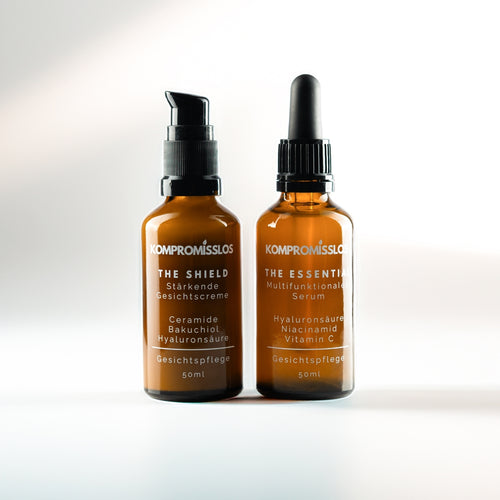
What you can realistically expect, then, is a softer overall impression, not a line that has vanished. In her review on Judge.me, Nicole B. writes: ‘The fine lines don’t go away, which isn’t really the idea anyway […], but the overall expression becomes softer’ (review translated from German). That is exactly the right expectation. In The Duo of serum and cream, the serum The Essential supplies the skin with hyaluronic acid in three molecular sizes and niacinamide, while the cream The Shield adds a supple layer on top with ceramide NP, bakuchiol and squalane. During the day, you add a separate sunscreen, because the skincare does not contain any.
Do wrinkle patches and tapes work overnight?
At best, wrinkle patches and tapes deliver a visible but temporary effect: in the morning, your frown lines may look smoother, but they return over the course of the day. The principle is mechanical. The patch holds the skin between your brows in a smooth position for hours, so you cannot frown in your sleep. According to manufacturers, silicone patches also help hold moisture in the outermost layer of the skin. Independent published studies on such patches are scarce, and the claims are mostly based on manufacturers’ own information. A lasting change to the line has not been shown. If you want to try them, keep an eye on your skin: on sensitive skin, the adhesive can cause redness and itching, and peeling a patch off every day puts strain on the skin’s surface. Sticking patches on irritated or broken skin is best avoided. As an occasional aid before a special occasion, they are harmless. As a solution for an etched-in line, they are overrated.
If a patch leaves noticeable redness or a burning sensation in the morning, stop using it. Irritated skin between your brows draws more attention than the line you wanted to smooth.
Which everyday habits deepen frown lines, and what can you change?
Frown lines are deepened above all by habits that make you knit your brows unconsciously and for long periods: squinting against the light, straining to see and focused work at a screen. Many people only notice how often they frown once they start paying attention to it. The aim is not to train yourself into an expressionless face, but to defuse the most common constant triggers.
- Sun and glare: a good pair of sunglasses saves you the squinting. Sunscreen on your face is part of it too, because UV light weakens the skin’s ability to spring back. What you need for that is covered in the article on sunscreen for your face.
- Uncorrected eyesight: if you can only see small print or your screen clearly by narrowing your eyes, you frown all day long. In that case, an eye test with an ophthalmologist or optometrist is worth doing anyway.
- Screen work: adjust the brightness, make the text larger and check the distance. Small adjustments like these take a lot of strain out of your face.
- Tension: people who frown under pressure often do so without noticing. Whether stress also takes a toll on the skin itself is covered in the article on what chronic stress does to your skin.
- Sleeping position: if you sleep on your side or your front, you press your face into the pillow at night. A review in the Aesthetic Surgery Journal describes how such sleep wrinkles are caused by external pressure and pulling forces, and how they differ from expression lines in cause, location and pattern. For frown lines, your facial expressions are therefore the bigger lever.
When are frown lines no longer a skincare issue?
Frown lines are no longer a skincare issue when they stay deep even with your face relaxed and bother you enough that you want them visibly smoothed. At that point, there are two medical options worth knowing about, without either being recommended here. Botulinum toxin is a medicine that a doctor injects into the muscles between the brows to inhibit them temporarily, so the skin folds less. Fillers are also injected by professionals and fill an etched-in line from below. Both only work for a limited time and have to be repeated, both have possible side effects, and both belong in the hands of an experienced doctor who advises you beforehand. Seeing a doctor also makes sense if your face changes suddenly, for example if one eyebrow droops or one side of your face seems weaker. That is not a wrinkle question. Whether your skincare should change after such a treatment is a separate topic. Skincare and medical treatment are not mutually exclusive; they simply do different jobs.
When it comes to an expression line, I do not promise anything a cream cannot deliver. No skincare relaxes a muscle, which is why we never claim anywhere that your frown lines will disappear. In The Shield, I chose bakuchiol instead of retinol, because retinol often irritates sensitive skin in particular, and skincare only does something if your skin can tolerate it every day. I deliberately did not put an SPF in the cream. A separate sunscreen is one you apply deliberately and generously enough, and with frown lines in particular, every squint in the sun counts. So: two products for the skin’s surface, plus a separate sunscreen and a pair of sunglasses. We disclose which active ingredients at which concentrations are in the Duo.
Frequently asked questions
Can you massage away frown lines?
No, you cannot massage away frown lines. A gentle massage while applying your cream loosens things up briefly and spreads the product, but the line stays because the muscle keeps working. A pilot study on facial exercises in JAMA Dermatology found improvements in cheek fullness, but not in the lines between the brows, with only 16 women completing the study and no control group.
Does hyaluronic acid help with frown lines?
Hyaluronic acid in a cream or serum helps the skin’s surface, not the line itself. It binds water in the upper layers of the skin, so the skin looks plumper and the line softer for as long as the skin stays well hydrated. It does not fill in an etched-in line. That is something different from a hyaluronic acid filler injected by a doctor.
Does a frown line on one side only mean anything?
A frown line on one side only usually comes down to habits, such as the side you sleep on or one eye that sees less well and gets narrowed more often. Faces are never completely symmetrical anyway. But if an asymmetry appears suddenly and for the first time, or if an eyebrow or the corner of your mouth droops, see a doctor straight away.
Can glasses or sunglasses prevent frown lines?
Glasses cannot prevent frown lines, but they can remove a common trigger. If your eyesight is uncorrected or you squint in glare, you pull your brows together many times a day. Glasses with the right prescription and a pair of sunglasses reduce that squinting. If you notice you often narrow your eyes, get your eyes tested.
At what age do frown lines appear?
There is no fixed age. As a dynamic line that shows when you frown, it is visible early on in many people. Whether and when it also stays when your face is relaxed depends on how often you frown, sun exposure, skin type and genetics. Paying attention early to sunglasses, sunscreen and good eyesight tends to push that point further back.
Do retinol or bakuchiol help with frown lines?
Retinol and bakuchiol act on the skin, not on the muscle that creates frown lines. Over weeks, they can make the skin’s surface look more even, but the expression line itself remains. Which of the two suits you is mainly a question of tolerance. There is more on this in the comparison bakuchiol or retinol for sensitive skin.
What can The Duo do for frown lines, and what can it not do?
The Duo hydrates the skin between your brows and makes it more supple, so the line looks less pronounced when your face is at rest. It does not relax the muscle, and an etched-in line will not disappear with it. Applied morning and evening after cleansing, with a separate sunscreen during the day, The Duo is skincare for the skin’s surface, nothing more.
Sources
- Yu M, Wang SM. Anatomy, Head and Neck, Eye Corrugator Muscle. StatPearls, 2023. Source
- Anson G, Kane MA, Lambros V. Sleep Wrinkles: Facial Aging and Facial Distortion During Sleep. Aesthetic Surgery Journal, 2016. Source
- Alam M, Walter AJ, Geisler A, Roongpisuthipong W, Sikorski G, Tung R, et al. Association of Facial Exercise With the Appearance of Aging. JAMA Dermatology, 2018. Source