Combining gentian root extract: what goes with it and what actually matters
INGREDIENT COMBINATION
Combining gentian root extract is straightforward: the root extract gets on with niacinamide, vitamin C, hyaluronic acid, ceramides, squalane, bakuchiol, zinc and panthenol, because it is used at a low dose and doesn’t need a particular pH. There is no need to separate them in time. The only rule worth following concerns the order: light textures first, rich ones last.
Combining gentian root extract: why there is almost never a conflict
Gentian root extract is a water-soluble plant extract used at a low dose, and that is precisely why combining it with other skincare ingredients practically never causes a conflict. It doesn’t need a narrow pH window, it doesn’t compete with any common active ingredient for the same mechanism, and it isn’t used in amounts at which an interaction would carry any weight. According to a systematic review in the journal Phytochemistry, the main groups of compounds in the root extract are secoiridoids such as gentiopicroside and sweroside, along with xanthones and flavonoids. None of these groups is known to deactivate niacinamide, vitamin C or hyaluronic acid. So the real question is not whether the extract interferes with anything, but whether it still adds anything alongside adequately dosed active ingredients. What the extract does on its own is covered in our article on what gentian root extract does and how to use it. For the bigger picture across all ingredient pairings, see our overview of ingredient combinations.
| Combined with gentian root extract | In the same routine | What to watch |
|---|---|---|
| Niacinamide | Yes | No conflict, same aim |
| Vitamin C | Yes | Stable forms are unproblematic, serum first |
| Hyaluronic acid | Yes | On slightly damp skin, cream afterwards |
| Ceramides | Yes | The lipid-rich layer goes on last |
| Squalane | Yes | Oily component after the water-based serum |
| Bakuchiol | Yes | No need to separate them in time |
| Zinc | Yes | Often in the same formulation |
| Panthenol | Yes | Combines well, similar role |
| Edelweiss extract | Yes | Two extracts don’t double anything |
Can you use niacinamide and gentian root extract together?
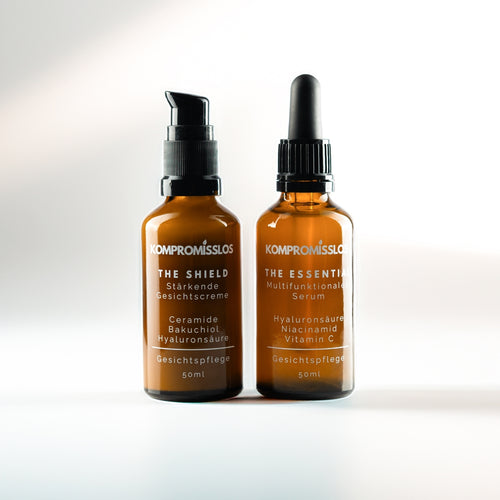
Yes, niacinamide and gentian root extract can be used in the same routine without restriction, and they don’t get in each other’s way in terms of what they do either. Niacinamide is a form of vitamin B3 and can be dosed at a fixed concentration; the root extract is a supporting ingredient. There is no known interaction between the two, and no pH conflict either. What is interesting is that they point in the same direction: in a study in the International Journal of Cosmetic Science, a test group of 22 people applied a cream containing a gentian root extract twice a day for two weeks in a split-face comparison, and the treated side showed less roughness and less redness around the eyes than the placebo side. An honest assessment needs two caveats: the study comes from the raw-material manufacturer’s own team, and it tests a specific extract, not a finished product. In The Duo of The Essential serum and The Shield cream, 5% niacinamide and 2% gentian root extract already sit side by side. All percentages refer to the Duo as a whole.
Can you use vitamin C and gentian root extract together?
Yes, vitamin C and gentian root extract get on well, and with stabilised forms of vitamin C the question of pH doesn’t even arise. Pure ascorbic acid needs an acidic environment to stay stable, and that is exactly where some plant extracts can discolour or turn cloudy. Stable derivatives such as 3-O-ethyl ascorbic acid work in a more moderate range and are considerably less sensitive to their surroundings. For you, that means you can apply a vitamin C serum and a product containing gentian root extract one straight after the other, with no waiting time and no need to split them between morning and evening. The vitamin C doesn’t lose stability, and the extract doesn’t lose its function. As always, the order follows the texture: the light serum first, then the richer cream. Why we chose this form of vitamin C is explained in our article on 3-O-ethyl ascorbic acid as a stable form of vitamin C. The Duo contains 2% of it.
Can you use ceramides, squalane and gentian root extract together?
Yes, ceramides, squalane and gentian root extract are one of the least problematic combinations of all, because they sit in different phases of a formulation. The root extract is water-soluble; ceramides and squalane are lipids. The two groups don’t compete for the same job – in the finished formula they simply sit side by side. That is exactly why you find this combination in so many formulations. One laboratory finding is worth mentioning: according to a study in the International Journal of Molecular Sciences, a Gentiana lutea extract increased lipid synthesis in cultured human keratinocytes and raised the expression of ceramide synthase 3. That is a cell-culture result with a specific extract, not proof for a finished cosmetic product, so no promises about effects can be drawn from it. In practice, the texture rule still applies: water-based serum first, lipid-rich skincare on top. Which other partners suit this group of ingredients is broken down in our article on which active ingredients work well with ceramides.
Can you use edelweiss extract and gentian root extract together?
Yes, edelweiss extract and gentian root extract can be combined without any problem – just don’t expect a double effect. Two plant extracts side by side don’t add up like two portions of the same active ingredient. Both belong to the same category of supporting ingredients, both are used at a low dose, and neither can carry a formulation on its own. The combination makes sense where it rounds off a formula that is already lean, rather than covering up a thin base of active ingredients. A third or fourth extract will, as a rule, give you nothing the second doesn’t already cover. So the more honest thing to check is something else: look at whether there are enough dosed active ingredients alongside the extracts at all. If an Alpine plant appears in large letters on the packaging and niacinamide or hyaluronic acid only turn up at the end of the INCI list, you are buying a story, not a formulation. Our products contain both extracts at 2% each, as you can check in the full overview of all ingredients.
A rule of thumb for every combination involving plant extracts: the order depends on the texture, not on the extract. Water-based before oily, light before rich. Everything else is fine-tuning that won’t make any visible difference to you.
When gentian root extract adds nothing, and when a professional should decide
You don’t need gentian root extract if your skin is stable, doesn’t feel tight after cleansing and takes new products in its stride. In that case, humectants, lipids and adequately dosed active ingredients determine the result, and an extra extract changes little. It also makes little sense to add a third product just for this ingredient when your serum and cream already contain it. You would be paying twice for the same role without your skin getting any more out of it. And there is a clear line where dermatology takes over: persistent or spreading redness, weeping patches, severe flaking, itching that disturbs your sleep, and skin changes that alter in shape or colour need to be checked by a doctor rather than handled with a skincare routine. The same applies if you suspect a contact allergy or already have a skin condition under medical care. Cosmetics care for the appearance of your skin and support the skin barrier; they replace neither diagnosis nor treatment.
I deliberately set gentian root extract and edelweiss extract at 2% each and didn’t give them a leading role. The obvious alternative would have been to make the two Alpine plants the main story, because Swiss origin sells well. I preferred to be able to give figures that mean something, and those belong to niacinamide, hyaluronic acid and vitamin C. The extracts make the result more rounded; I never expected more of them than that. How it all works day to day is set out in the guide to using the serum and cream. If that sounds too sober for you, our Duo of two products is probably the wrong choice.
Frequently asked questions
Can you use panthenol and gentian root extract together?
Yes, without restriction. Panthenol is water-soluble, well tolerated and doesn’t depend on a particular environment for its conditioning effect. No interaction with the root extract is known. The two appear side by side in many formulations anyway, because they take on similar tasks and don’t rule each other out.
Can you use zinc PCA and gentian root extract together?
Yes, zinc PCA and gentian root extract get on well in the same routine and often even in the same formulation. Both are water-soluble and don’t need to be separated in time. The Duo contains 1% zinc PCA; like all our percentages, this figure refers to the serum and cream together.
Can you use bakuchiol and gentian root extract together?
Yes, and you don’t need to change anything to do so. Bakuchiol is not sensitive to pH and doesn’t make the skin as sensitive to light as retinol does. No mutual deactivation with the root extract is known. In the Duo, 0.3% bakuchiol and 2% gentian root extract are already part of the same routine.
Can you use hyaluronic acid and gentian root extract together?
Yes, this is one of the simplest combinations. Hyaluronic acid binds water in the upper layers of the skin, the root extract has a different role, and both are water-soluble. Apply the serum to slightly damp skin and the cream on top, so that the moisture that has been drawn in doesn’t simply evaporate. The Duo contains 2% hyaluronic acid.
In what order do you apply gentian root extract?
According to the texture of the product it is in, not the extract itself. If it is in a water-based serum, it goes on early; if it is in a cream, it goes on late. The rule is: cleanse, light serum, rich moisturiser. In the morning, finish with sun protection.
Do you need to keep gentian root extract apart from acids or retinol?
No, there is no need to separate them in time. The extract doesn’t work through irritation and isn’t deactivated by an acid. If your skin reacts sensitively while it gets used to retinol or acids, that is down to those active ingredients, not to the plant extract used alongside them.
Does The Duo contain gentian root extract?
Yes, at 2%, alongside 2% edelweiss extract, 5% niacinamide, 2% hyaluronic acid, 2% vitamin C as 3-O-ethyl ascorbic acid, 1% zinc and 0.3% bakuchiol. All percentages refer to The Duo of The Essential serum and The Shield cream together, not to a single product. You will find the full list on our ingredients page.
Sources
- Ponticelli M, Lela L, Moles M, Mangieri C, Bisaccia D, Faraone I, Falabella R, Milella L, The healing bitterness of Gentiana lutea L., phytochemistry and biological activities: A systematic review, Phytochemistry, 2023. Source
- Berthon JY, Cabannes M, Bouton C, Carre M, Bridon E, Filaire E, In vitro, ex vivo and clinical approaches to evaluate the potential effect of Gentiana lutea extract on skin, International Journal of Cosmetic Science, 2023. Source
- Wölfle U, Haarhaus B, Seiwerth J, Cawelius A, Schwabe K, Quirin KW, Schempp CM, The Herbal Bitter Drug Gentiana lutea Modulates Lipid Synthesis in Human Keratinocytes In Vitro and In Vivo, International Journal of Molecular Sciences, 2017. Source