Niacinamide and vitamin E: what you actually need to know about combining them
INGREDIENT COMBINATION
Combining niacinamide and vitamin E is perfectly safe: the two active ingredients don’t react with each other and work in different areas of the skin. Niacinamide is water-soluble and supports the skin barrier; vitamin E is fat-soluble and protects the skin’s lipids from oxidation. Used together in one routine, they make more sense than either ingredient on its own.
Can you use niacinamide and vitamin E together?
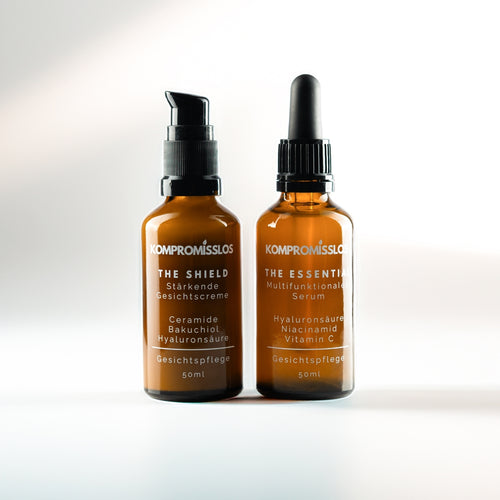
Yes, you can use niacinamide and vitamin E together without restriction. There is no known mechanism by which the two substances break each other down or block each other’s effect. The reason lies in their chemistry: niacinamide is water-soluble and is distributed in the water phase of a formulation, while vitamin E is fat-soluble and sits in the oil phase. So they occupy different places rather than competing for the same one. That is exactly why both have appeared together on the ingredient lists of serums and creams for decades, including The Duo of serum and cream. Concern about interactions almost always stems from a different debate – the one about niacinamide and vitamin C. That discussion has been put into perspective considerably in recent years, and it doesn’t concern vitamin E anyway. If you keep the two apart, you are more likely to be missing out than avoiding a risk.
What does niacinamide do for the skin?
Niacinamide is the amide form of vitamin B3 and acts mainly on the skin’s barrier function. In a study published in the British Journal of Dermatology, nicotinamide markedly increased the synthesis of ceramides in cultured human keratinocytes and improved the permeability barrier of the epidermis. Ceramides are the mortar between the skin cells of the outermost layer, and the more stable this mortar, the less moisture the skin loses to the outside. In a twelve-week clinical study, 5% niacinamide applied twice a day led to visible improvements in fine lines, blotchiness and skin tone. The Duo as a whole contains exactly this concentration of 5% niacinamide. Because niacinamide can also soften the look of redness and enlarged pores, it often comes up in discussions about blemish-prone skin. For how it compares with vitamin C, see the comparison of vitamin C and niacinamide.
What does vitamin E do for the skin?
Vitamin E is your skin’s most important fat-soluble antioxidant reserve. A review in Molecular Aspects of Medicine describes alpha-tocopherol as the predominant form of vitamin E in human skin and attributes barrier-stabilising and photoprotective properties to the molecule. Its place is the lipid layer: there it neutralises reactive oxygen species before they can attack the skin’s lipids. The reserve in the uppermost layer of the skin falls measurably when UV radiation hits the skin, which is why a daily supply through your skincare makes sense. A second, often overlooked benefit lies in the formulation itself: vitamin E protects the plant oils it contains from going rancid and so extends the stability of a product. That isn’t a marketing argument but the reason why vitamin E appears on so many ingredient lists without being heavily advertised.
Why niacinamide and vitamin E complement each other
The combination makes sense because the two active ingredients tackle different jobs. Niacinamide works on the substance of the barrier by stimulating the skin’s own lipid production. Vitamin E works on protecting those lipids once they are there. A barrier that is rebuilt but not protected from oxidation loses some of what it has gained. Conversely, protection is of little use if there isn’t enough substance to protect. That is why asking which active ingredient is better is the wrong question. It makes more sense to choose a formulation that covers both levels and brings in other building blocks too, such as ceramides, squalane or gentian root extract as a plant-based addition. In practice you won’t notice any of this, because a good formulation already reflects this division of labour. The distinction only becomes relevant when you are considering whether to buy an additional product. The table below gives an overview of how the work is divided.
| Feature | Niacinamide | Vitamin E |
|---|---|---|
| Solubility | Water-soluble | Fat-soluble |
| Phase in the product | Water phase | Oil phase |
| Main job | Supports the building of the skin barrier | Protects skin lipids from oxidation |
| Stated in the Duo | 5% | Included, no percentage stated |
In what order should you apply niacinamide and vitamin E?
The order depends on texture, not on the active ingredient: light before rich. In practice, that means serum first, cream second, morning and evening, each time on cleansed skin. With the Duo, that is 3 to 6 drops of serum followed by 3 to 6 pumps of cream, depending on how your skin feels and the time of year. You don’t need to wait between steps; it is quite enough for the serum to have sunk in briefly so that your skin no longer looks wet. If both active ingredients are in the same skincare system anyway, the question of timing disappears completely, because the formulation has already taken care of the distribution. You’ll find detailed guidance on amounts and frequency on the page about how to use the serum and cream. The only thing that matters is consistency, because changes to your complexion take weeks, not days. If you also use a sunscreen, it goes on top as the last step in the morning.
When a professional is the better person to ask
Skincare cares for your complexion; it doesn’t replace a diagnosis. If your skin keeps weeping, flakes heavily, itches or patches change, that belongs with a dermatologist, not in a skincare routine. The same applies to reactions that appear shortly after using new products and don’t subside by themselves within a few days. Neither niacinamide nor vitamin E treats skin conditions, and no cream replaces a medical assessment. What good skincare can do is provide daily support for an intact barrier and a more even-looking complexion. What customers observe in everyday life is collected on the page of reviews of the Duo. If you are already having treatment, it is best to discuss new products beforehand with the professional treating you, especially when prescription active ingredients are involved. That, too, is part of honest skincare: saying where it ends.
I deliberately put niacinamide and vitamin E into the same system rather than splitting them across two purchasing decisions. The reason is simple: the question I am asked most often is not which active ingredient, but how many products you need. My answer is two. Water phase and oil phase, building and protecting, morning and evening. Anything more would, for me, be about shelf space rather than benefit to your skin. That’s why you’ll find both active ingredients together in one Duo instead of two separate products. And that’s why I state the concentrations openly – and say so where I can’t give a figure.
Frequently asked questions
Can I use niacinamide and vitamin E on the same day?
Yes, niacinamide and vitamin E can be used on the same day and even in the same step. There are no known interactions that would make it necessary to keep them apart. Both active ingredients are suitable for use morning and evening, provided your skin tolerates the products well.
Does vitamin E go on before or after niacinamide?
The order follows the texture, not the active ingredient. Light, watery products go on first, richer ones afterwards. As niacinamide is usually found in serums and vitamin E usually in creams, this automatically means serum before cream. If both are in the same product, the question doesn’t arise.
Do niacinamide and vitamin E cancel each other out?
No, the two active ingredients don’t cancel each other out. Niacinamide is water-soluble, vitamin E is fat-soluble, and they act at different points in the skin. The widespread worry about clashing active ingredients relates to other combinations, usually niacinamide together with pure ascorbic acid.
How much niacinamide makes sense in skincare?
In clinical studies, visible effects on the complexion were observed with 5% niacinamide over twelve weeks. Higher concentrations don’t automatically do more, but they are more likely to cause tingling on sensitive skin. The Duo as a whole contains 5% niacinamide.
Is vitamin E a problem for oily skin?
Vitamin E is fat-soluble, but it is used in cosmetic amounts and doesn’t automatically make a formulation heavy. What matters is the formula as a whole, not the individual active ingredient. If your skin tends to get shiny, pay more attention to how much cream you apply than to vitamin E itself.
Do I need two separate products for niacinamide and vitamin E?
No, two separate products aren’t necessary. Both active ingredients can be combined in one routine, often even within the same formulation. Separate products only make sense if you want to control a particular concentration or if your skin doesn’t respond to a specific product.
How long does it take to see a difference in your complexion?
Allow eight to twelve weeks of consistent use. Hydration and skin feel often change within a few days, whereas effects on evenness and fine lines were only recorded over several weeks in studies. Irregular use extends this period accordingly, because the skin is constantly renewing itself.
Sources
- Tanno O, Ota Y, Kitamura N, Katsube T, Inoue S. Nicotinamide increases biosynthesis of ceramides as well as other stratum corneum lipids to improve the epidermal permeability barrier. British Journal of Dermatology, 2000. Source
- Bissett DL, Oblong JE, Berge CA. Niacinamide: A B Vitamin that Improves Aging Facial Skin Appearance. Dermatologic Surgery, 2005. Source
- Thiele JJ, Ekanayake-Mudiyanselage S. Vitamin E in human skin: organ-specific physiology and considerations for its use in dermatology. Molecular Aspects of Medicine, 2007. Source