Best natural skincare in Switzerland: the criteria that really matter
NATURAL SKINCARE SWITZERLAND
The best natural skincare in Switzerland doesn’t exist as a single brand, because “best” always means best for which skin. What matters are four criteria you can check: a complete list of ingredients, disclosed concentrations of active ingredients, a routine you can keep up every day, and a returns period that runs long enough. Rankings can’t answer this, because they are made for an average.
Is there such a thing as the best natural skincare in Switzerland?
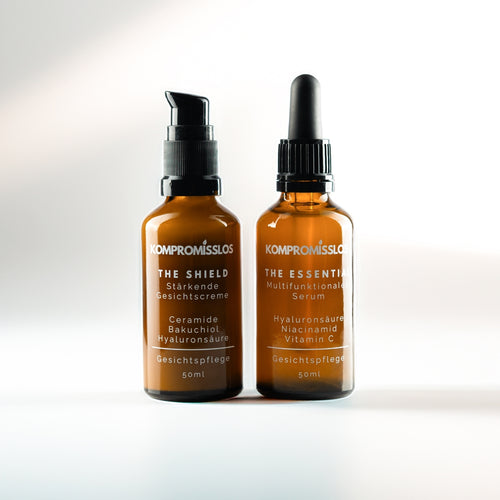
No – at least not as a single brand that would be right for everyone. “Best” describes a relationship between a product and a particular skin at a particular time, not a fixed property of a jar. A cream that suits your colleague with rather oily skin in July may make your skin feel tight in February. The product hasn’t changed in the meantime; the skin has. This is exactly where rankings fall down: they award places according to a criterion that may only be third on your list, and they ignore the fact that tolerance is individual. What you need instead is a short list of points you can check yourself on any product before you pay. These points are unspectacular, and that is precisely why they hold up. With The Duo of serum and cream, we have tried to make every one of them answerable rather than relying on a promise.
What criteria should you use to judge a brand?
Six points that you can check yourself in a few minutes, without specialist knowledge and without relying on other people’s ratings. The order in the table is deliberate: what is at the top has more influence on your results than what is at the bottom. It is striking that none of these points has anything to do with fragrance, packaging or brand story. Those are the things that catch your eye on the shelf straight away, and at the same time the things that tell you least about how well a product works. If a brand doesn’t answer one of these questions, that is an answer in itself – and a useful one. Publishing a detailed overview of all ingredients with their concentrations requires no technology, just the willingness to make yourself comparable. That is exactly what you can measure a brand by, long before you apply anything for the first time.
| Criterion | How to check it | What it tells you |
|---|---|---|
| Complete ingredient list | Can you find the list under Ingredients in the online shop too, not just on the pack? | Whether you can judge what’s in it before you buy. |
| Concentrations stated | Does the brand give percentages for the main active ingredients? | Whether an active ingredient is properly dosed or just on the label. |
| Size of the routine | How many products do you need to use it as intended? | How realistic it is that you’ll keep the routine up for months. |
| Returns period | How long can you return it, and does that apply once opened? | How much of the risk of trying it lies with you. |
| Cost per application | How long does a bottle last at the rate you use it? | What your skincare actually costs you each month. |
| Accessibility | Do you get a concrete answer to a question about tolerance? | Whether there is someone behind the brand who knows the formula. |
Why does an ingredient list without percentages tell you so little?
Because the list of ingredients only gives a rough idea of quantity, and below a certain threshold none at all. Under the Swiss Ordinance on Cosmetic Products (VKos), it must appear on the packaging under the heading Ingredients in descending order of quantity, but ingredients below one per cent by mass may be listed at the end in any order. In practice, this means that as soon as an active ingredient appears towards the bottom of the list, all you know is that it makes up less than one per cent. Whether that is 0.8% or 0.01%, you can’t tell. That is why a voluntary percentage is the most honest signal a brand can give. It makes the brand open to challenge and comparable. A brand that leaves it out isn’t necessarily hiding anything, but you simply can’t verify anything either. This applies to vitamin C and niacinamide just as much as to plant extracts.
One more point about the label: water is almost always listed first, and that’s normal. Plant extracts such as gentian root extract often appear far down the list, too, even though they may be sensibly dosed. Position alone is not enough to judge by.
How many products does a good routine need?
Fewer than most shelves suggest – and above all, few enough that you actually use them morning and evening. A routine doesn’t work because it has lots of steps, but because it stays the same over weeks. With eight products, two things regularly happen: on tired evenings you skip half of them, and if your skin reacts, you can’t say what to. With two products, you have exactly two variables. That is why our range consists of one serum and one cream and nothing else. A large range isn’t a disadvantage in itself, though; it just shifts the work onto you, because you then have to decide for yourself what goes together. When comparing two brands, this means not counting the number of products but setting the cost and time needed for a complete routine side by side.
How do you find out what suits your skin best?
By testing a new product for long enough and on its own, rather than changing several things at once. The surface of the skin renews itself over weeks, so the first week tells you almost nothing. A sensible period is at least four to six weeks, during which you introduce nothing else new, start no additional exfoliation and keep your application the same. With us, that means three to six drops of serum and three to six pumps of cream, morning and evening; the exact order of application is described separately. At the start, note down two or three specific things you want to watch, such as tightness after washing or redness around the nose. Without that note, you will almost always overestimate the change in hindsight. If you are currently dealing with blemish-prone skin, the same rhythm applies – just with even more patience.
When is natural skincare not the right choice?
Whenever there is something behind the state of your skin that needs to be looked at. Cosmetics care for the skin and support its barrier; they don’t replace a diagnosis. Severely inflamed areas, rashes that spread quickly, changes to moles or persistent itching belong with a dermatologist, not in a buying decision between two brands. If you already use prescribed treatments, it is also best to check any additional skincare with a professional beforehand. And to be just as honest: if you have a routine your skin has been happy with for years, there is no reason to switch. The best time for a new product is when something specifically no longer works. Natural skincare is also not a legally defined term: according to the Federal Food Safety and Veterinary Office (FSVO), what is regulated is the safety, labelling and ban on misleading claims for cosmetic products in general, not the term itself. Our serum and cream as a set are cosmetic products too, and nothing more.
I’m often asked why we never compare ourselves with other Swiss brands. The reason is simple: to do so, I would have to pretend I know your skin. I don’t. What I can influence is how much you know about our products before you order. That is why all the concentrations are out in the open, why there are two products and not eight, and why you have 100 days to return them. If after that time you realise it isn’t for you, the decision was still the right one to make, because it was based on verifiable information and not on a ranking. That is what matters to me.
Frequently asked questions
What is the best natural skincare in Switzerland?
There is no brand that is best for everyone. The question only makes sense with an addition: best for which skin condition, which budget and how much time. Instead, check the complete ingredient list, disclosed concentrations, the size of the routine and the returns period – then you are deciding on a sound, transparent basis.
Is natural skincare legally defined in Switzerland?
No, there is no specific legal definition of the term natural skincare itself. What is regulated is the safety, labelling and ban on misleading claims for cosmetic products in general. What counts as natural is set out by private standards such as NATRUE or COSMOS, and their requirements differ from one another.
How can I tell whether a product contains enough of an active ingredient?
Only from a percentage stated by the brand. The order of ingredients only reveals quantities above one per cent by mass; below that, they may be listed in any order. There is a big difference between 0.8% and 0.01%, and you can’t see it from the list alone.
How long should I test a new product?
Allow four to six weeks, during which you introduce nothing else new. The surface of the skin renews itself over weeks, so the first week tells you little. At the start, note down two or three things you want to watch; otherwise you will overestimate the change in hindsight.
Are expensive products better than cheap ones?
Not automatically. Price says little about dosage, because packaging, marketing and distribution can account for a large share of it. The cost per application is more telling: how long does a bottle last at the rate you use it, and how many products do you need for a complete routine?
How much does The Duo cost and how long does it last?
The Duo of serum and cream costs CHF 109.90. Used morning and evening, with three to six drops of serum and three to six pumps of cream, a bottle lasts two to four months, depending on how often you use it. Delivery costs CHF 3.70 and is free on orders over CHF 60.
What does a natural skincare seal do for me?
It makes a promise verifiable, because there is a written standard behind it. But it says nothing about whether a product suits your skin or whether the active ingredients are sensibly dosed. So a seal doesn’t replace looking at the ingredient list and the concentrations.