Swiss natural skincare start-ups: what young brands do differently
NATURAL SKINCARE FROM SWITZERLAND
A Swiss natural skincare start-up usually works with a small number of products, small batches and direct sales with no retailer in between. The result is more openly stated concentrations of active ingredients, a short line to the founders and a narrow selection instead of a full shelf. Legally, exactly the same requirements apply as for an international corporation.
What does a Swiss natural skincare start-up do differently from a big brand?
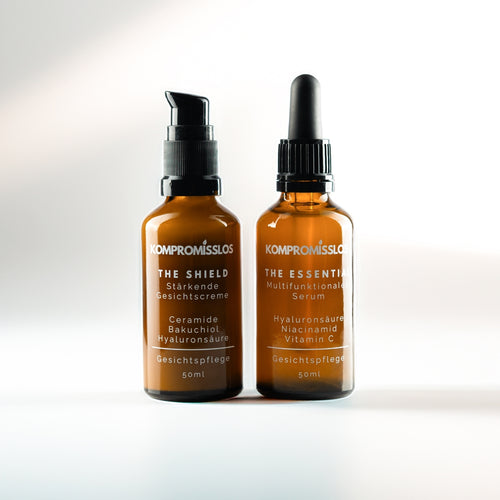
The biggest difference lies not in the formula but in the business model. A young brand usually sells directly to you, without a chemist’s, a major retailer and the margins in between. That changes three things. First, the breadth of the range: if you don’t have shelf space to defend, you don’t need twelve variants of the same cream and can limit yourself to a few products. Second, communication: small brands more often state concrete concentrations, because they have to stand out through substance rather than name recognition. With us, the full list is on the page for our Duo of serum and cream, including percentages. Third, batch size: small fill quantities mean fresher products, but also higher unit costs and less of a buffer if a raw material suddenly becomes unavailable. None of these points is automatically better. They are simply different trade-offs that you should know about before you order from a new brand.
How can you tell whether a young brand works properly?
You can tell from four things, all of which you can check without specialist knowledge. First, the complete ingredient list in INCI nomenclature, directly on the product page and not just on the packaging. If it is missing online, that is a bad sign, because the information exists anyway and simply isn’t being shown. Second, a genuine company address in Switzerland with the name of the responsible person, not just a contact form. Third, claims you can follow: concrete percentages, clear instructions for use and honest limits are a better signal than promises of a new face in four weeks. Fourth, a fair returns policy, because nobody can tell you in advance how your skin will react to a new product. If you want to see what such a list looks like, take a look at our page on the active ingredients we use and their concentrations and compare it with what other brands show you.
Do the same legal rules apply to a start-up as to a big corporation?
Yes, and that is the point most people underestimate. In Switzerland, cosmetic products are subject to the Swiss Ordinance on Cosmetic Products (VKos), and it makes no allowances for small companies. Every product requires a safety assessment by a suitably qualified professional, as well as a product information file that is made available to the authorities on request. Whoever places a product on the market bears this responsibility personally, regardless of whether it is manufactured in-house or by a contract manufacturer. Manufacturing follows the rules of good manufacturing practice, although according to the Canton of Aargau’s fact sheet on the distribution of cosmetics, certification of the facility is not required. It is also prohibited to give the impression that a product has been authorised or approved by an authority. In other words, there is no state body in Switzerland that approves or awards a face cream. Anyone who claims otherwise in their advertising is not telling the truth, whether they have been on the market for thirty years or for one.
Where a small brand is strong and where the big corporation wins
The strength of a small Swiss brand lies in depth; that of a corporation in breadth. A start-up can tell you why exactly this active ingredient is in there in exactly this amount, and the answer often comes from the person who made the decision. A corporation, on the other hand, can invest in tolerance studies over years, deliver to twenty countries and offer products for every conceivable skin condition. When it comes to regional raw materials, both work with the same suppliers, because alpine plants such as gentian root extract and its effect on the skin are not a start-up privilege. The laboratories where products are filled and tested are often the same, too. The difference comes later: in how much of this is communicated to the outside world and how quickly a formula can be changed. A small team decides in days, a corporation in quarters. On the other hand, a corporation survives a mistake that would cost a young brand its business. The overview below shows where the differences really lie – and where differences are often claimed that don’t exist.
| Criterion | Small Swiss brand | Established big brand |
|---|---|---|
| Range | A few products, often designed as a set routine. | Broad range for many skin conditions and price points. |
| Information on active ingredients | Concentrations are more often stated openly. | Level of detail varies from brand to brand. |
| Batches | Small quantities, but shorter storage times. | Large quantities with high availability. |
| Legal obligations | Identical, with no concessions for size. | Identical, with more in-house resources to meet them. |
| Body of experience | A few hundred pieces of feedback rather than decades. | A very large body of data over many years. |
| Accessibility | Answers often come directly from the founders. | Answers come via a customer service team. |
When a start-up product is not the right choice
There are situations in which a young brand is the wrong choice for you, and any brand should tell you honestly what they are. If you have a skin condition diagnosed by a doctor, you need a dermatological assessment, not cosmetics, however carefully they are formulated. Cosmetics care for the skin and support its appearance; they don’t replace treatment. Likewise, if you have a very specific requirement, such as a product with a particular sun protection factor or a formula free of one rare individual substance, you are more likely to find it in a broad range. And if you like to switch often and test lots of products in parallel, a set routine of just two products won’t fit your habits well. If your complexion is restless, it is worth looking at what actually helps with blemish-prone skin before you buy, because there the routine matters more than the brand.
How to test a new brand without wasting money
Always test a new brand on its own and never alongside a second change, or you won’t know in the end what worked. Give your skin four to eight weeks, because over shorter periods you mainly see effects of your skin getting used to something new. Keep your application constant during this phase: same amount, same order, morning and evening. With us, that means three to six drops of serum and three to six pumps of cream; the details are on the page about how to use serum and cream correctly. Depending on how often you use it, a bottle lasts two to four months, so you can judge at your leisure before you reorder. And check the returns period before you order: we give you 100 days, because an honest test simply takes longer than a week. You can read what others have to say in the feedback from our customers.
I started Kompromisslos with two products, even though several people advised me to begin with a broader line. The reason is simple: I wanted to be able to say, for every single active ingredient, why it is in there and in what amount. That is possible with two products; with twelve, I would have had to start filling gaps with marketing. The same thinking lies behind the openly stated percentages. They leave us open to challenge, because anyone can check the maths. That is exactly why they are there. If you want trust as a small brand, you have to show more than a big brand does, not less.
Frequently asked questions
What exactly is a Swiss natural skincare start-up?
It means a young, usually owner-managed company based in Switzerland that develops plant-based cosmetics and mostly sells directly. There is no protected definition. Neither the term start-up nor the term natural skincare is legally defined, so what counts is what the brand discloses about origin, formula and concentrations.
Is natural skincare from a start-up safe?
The legal requirements are the same as for any other brand. Every product requires a safety assessment by a qualified professional and a product information file. Company size plays no role. You can check this indirectly through the complete ingredient list and a clearly named responsible company with a Swiss address.
Does a small brand have to list all its ingredients?
Yes. The labelling requirements for cosmetic products call for a complete list of ingredients, regardless of company size. Percentage concentrations, on the other hand, are voluntary. If a brand states them, it is providing something it doesn’t have to, which makes it a useful signal for you.
Why does skincare made in Switzerland often cost more?
Small batches spread development, filling and testing costs over fewer units, and on top of that come higher wage and production costs in Switzerland. Selling directly saves the retail margin but doesn’t fully make up for the smaller quantities. So compare the price per millilitre, not the price per bottle.
How can I tell whether a product really is made in Switzerland?
Look for specific wording. Made in Switzerland is a different claim from developed in Switzerland or filled in Switzerland. Reputable brands state which step happens where. If the information is missing or vague, ask directly before you order.
Can a start-up without a seal be trustworthy?
Yes. Seals are voluntary, paid-for certifications by private organisations, not official proof from an authority. They say something about compliance with a particular standard but nothing about how effective a formula is. The complete ingredient list, stated concentrations and a responsible company you can reach tell you more.
How long should I test a product from a new brand?
Allow four to eight weeks of consistent use, morning and evening. Shorter periods mainly show whether you tolerate the product well, not whether it changes anything. Depending on how often you use it, a bottle lasts two to four months. Check the returns period beforehand – with us, it is 100 days.